Wednesday, August 13, 2014

40: FALL CLASSES


No matter what your
measurements, all sewing
patterns can be graded
to fit you.
This fall Contemporary Fashion Education is offering two courses: Fitting Home Sewing Patterns/Grading to Fit on Saturday mornings, Design Room Techniques on Saturday afternoons. Prices, the fall schedule, and a link to the Course Order Form are found at the bottom of this post.

The Contemporary Fashion Education school is located in Oreland, PA, 19075, one mile from the PA turnpike Fort Washington exit. Oreland is 10 minutes northwest of Chestnut Hill, Philadelphia. Parking is free. Enrollment is limited to 6 students per class.

 From Conception to Production, a two-day master class is also offered. The class will be held October 15-16, at this year’s annual Association of Sewing and Design Professionals Education Conference in Philadelphia. The Conference will be held at the Wyndham Philadelphia Historic District Hotel in Old City. Information about From Conception to Production is found on this blog on Post 41:  SEMINAR - From Conception to Production.

This diagram shows how to draft an asymmetrical waistline.
Asymmetrical fit is addressed in the Fitting Home Sewing Patterns/
Grading to Fit course, its book Grading to Fit,
and the entire Contemporary Fashion Education program.
Well fitted asymmetrical clothing gives the wearer the
appearance of having a symmetrical. figure.
Fitting Home Sewing Patterns/Grading to Fit, offered Saturday mornings this fall, is the first of a 3-course series in which you will learn how to grade home sewing patterns to your custom fit. No matter what your measurements, readily available home sewing patterns can be graded to fit you. Understanding how to grade to fit eliminates the misery of fitting pattern after pattern. Here is the link to more information about this and the other courses.

Shown here is Laurel's master sample book for the course.
The sample book contains 60 pages with over 100 
samples. Mastering the material in this course will take the
misery out of your sewing. For example: you will learn how
to sew zippers with ease, matching seam line to seam line. 

In Design Room Techniques, offered Saturday afternoons this fall,you will make a sample book as you learn the basic sewing skills used in industry to produce high-end couture garments worth thousands of dollars. Here is the link to more information about this and the other courses.
Diagrammed books that show the procedures, step-by-step, 
enable students to speed through the course work. 

In all of the Contemporary Fashion Education classes you will learn how patterns are drafted, and how exquisitely made clothing is sewn in the industry’s high-end designing departments. You will use fully diagrammed books, written to support these courses. The books present, step-by-step, the procedures used by the best pattern makers and sample makers in the industry.

You will use these procedures, hands on, to draft patterns and produce samples, exactly as done by the professionals.

Laurel Hoffmann, instructor and author, is one of the top 1% most endorsed on @Linkedin in the United States for sewing. She worked as a production patternmaker/technical designer in the industry where she learned and did high-end couture sewing that sold at Saks and Bergdorf Goodman's in NYC and other stores. Her goal is to make high-end industrial patternmaking and sewing techniques available to everyone.


Fitting Home Sewing Patterns/Grading to Fit
12 three-hour classes on Saturday's
9pm to noon
Sep.13, 20, 27, Oct. 11, 25, Nov. 1, 8, 15, 22, Dec. 6,
Dec. 13 - 2 sessions: 9 am - noon, 1 pm to 4 pm
No classes Oct.4, 18, or Nov. 29
Course price: $425.00


Students also need to buy the textbook
Grading to Fit
$90.00 wholesale, plus $5.40 tax

Design Room Techniques
10 three-hour classes on Saturdays
1 pm to 4 pm
Sep. 13, 20, 27, Oct. 11, 25, Nov 1, 8, 15, 22, Dec 6
No classes Oct. 4, 18, or Nov. 29
Course price: $350.00


Students also need to buy the textbook 
Design Room Techniques
$100 wholesale + $6.00 tax

Ensure your place in the class by either calling Laurel at 215 884 7065 or by e-mailing her.
Questions? Call 215 884 7065 to speak with Laurel.
To register complete the Course Order Form and send it with the payment in by mail. Course fees must be paid in full before the first class day. No refunds after the first day of class. Payment can be made by check or money order to Contemporary Fashion Education, Box 74, Oreland, PA 19075. Only students who have paid for the course can buy its textbook(s) at wholesale price. Books can be shipped - or picked up the first day of class.

Laurel


e-mail

 Phone: 215 884 7065

© Laurel Hoffmann, 2014. All rights reserved.
All material on this blog is copyrighted by and is the exclusive right of Laurel Hoffmann.


Sunday, August 3, 2014

39: SIZING


Why the size of your clothing says little about your size was the topic on Radio Times with Marty Moss-Coane, July 30, 2014. The show began with this information:

The news that apparel company J Crew is now making a size 000 (that’s two sizes smaller than a 0!) created a stir among some feminists who say the new size idealizes the desire to be too thin. While the company says it is trying to appeal to a petite Asian market, critics say that the move is just another example of the “vanity sizing” trend in fashion – downsizing label sizing so customers, both women and men, feel better about the clothes they try on and buy.

Today on Radio Times we’ll talk about how size influences shoppers, how manufacturers make sizing decisions and why the size you wear doesn’t say much about the size you are.


I am addressing some of these women's fit issues in this post


But first - Some comments about scanning to fit

During the show one of the guests speculated that in time we may be able to scan our bodies at home, and then from the scanning know what brand and size we should buy, a complicated, currently expensive procedure that seems a long walk around the barn.

There is an easier device that can quickly determine one’s correct size. It’s called a tape measure. It is inexpensive, easy to use, and so small it is easily carried in one’s pocket. It is already in most homes. It has been used for centuries to determine sizing. It gives measurements in both metric and inches.  Comparing its results with a company’s measuring chart makes determining one’s size quite easy.


The tape measure has been used for centuries
to determine body measurements and
to produce clothing that fits. It works.
 

Why so much controversy about women’s sizing? One never hears about problems with men’s sizing


Men's clothing is labeled with real measurements, as shown in this shirt tag, sewn on the inside of the collar stand. The shelves in the stores are also labeled with the measurements, enabling men to find clothing with minimal effort that fits them.
Shopping for men is simple. If one knows the pant length and waist width, then one finds pants with those measurements – which are not only on the clothing labels, but also on the shelves where the pants are kept in the stores. The same is true for shirts, although unfortunately many companies are now going to small, medium, large, and extra large, even for men.

How to use the tape measure to determine a woman's best size


Even though women’s clothing is not marked in inches, you can still use the tape measure to determine a woman's best size in a particular brand:


First a little information about how sizing is developed: 

Companies first make a garment style in the sample size. Then, when the garment has sold and has been approved for mass-production, its pattern is graded in smaller and larger sizes that are proportionate to the sample size. The name of a size, such as S6 is jargon for the set of measurements the company uses to grade that size. A grade rule that is a comprehensives set of measurements for all the sizes in that size range. Grade rules are so essential to a company's ability to fit its customers, they are copy-righted.


How to determine what size fits

First go on the company’s website and search for its size chart.  If the company hasn’t posted its sizing chart online call the company and ask why. 

I chose to go on Landsend’s website. First I put in sizing chart
Then I hit women to access the company’s sizing chart for women.
And there were the measurements. The measurements that are listed in a sizing chart are just some of the many measurements that comprise company's grade rule for that size range. But they are the essential measurements needed to determine the size that will fit the best.

Now all I needed to do was measure the person for whom I was buying the clothing, then compare her measurements with Landsend's sizing chart to know what size she should buy.

About custom/mass-production

For a long time I have heard about the possibility of mass-production someday being able to produce custom fit clothing.  While mass-production has made it possible to almost everyone to buy ready-made clothing that more or less fits, custom/mass-production is to my mind an oxymoron.

Mass-production is only profitable if a company can manufacture 1000 garments a cut.  A cut usually includes five or six sizes, tagged so as to make sure those garments cut from the top of the spread fabric are sewn together and those cut from the bottom of the spread are sewn together so as not to have differences in the color shading. The cut pieces must also be bundled and overseen so as not to mix any of the sizes as the garments are being sewn. Imagine keeping track of 1000 separate garments, each garment, each cut to a slightly different body fit. It would require cutting each ply separately before we talk about any of the other problems. In my mind this scenario presents far too many problems for it to be in any way profitable. 

Industrial couture

High-end, expensive clothing is made for preferred customers in some manufacturers' high-end designing departments. Various department stores who cater to preferred customers buy the exclusive rights to individual, semi-custom high-end garment styles. Samples of the garment styles are put on the floor, the customer decides which she wishes to buy, her measurements are sent to the manufacturer, and the garments are cut and sewn in the manufacturer's designing department by the best hands in the manufacturer's designing department.

Laurel


e-mail

 Phone: 215 884 7065


Sunday, July 6, 2014

38: PATRICK KELLY EXHIBIT

 
Patrick Kelly: Runway of Love is a MUST SEE fashion exhibit, now showing in the Special Exhibitions Gallery, first floor, Perelman Building April 27, 2014 - December 7, 2014.


In this post I am presenting some of Patrick Kelly’s innovative clothing. To learn more about the designer, visit http://www.philamuseum.org/exhibitions/799.html which begins: “I want my clothes to make you smile”—that was the goal of late African American designer Patrick Kelly in creating his bold, bright, and joyful creations.


The show was curated by Dilys Blum, The Jack M. and Annette Y. Friedland Senior Curator of Costume and Textiles.

While on that website, http://www.philamuseum.org/exhibitions/799.html be sure to scroll down and read where Exhibition Assistant Laura Camerlengo  talks about presenting Patrick Kelly’s designs at the museum.  And watch the attached video. It’s really good.

Laura Camerlengo also curated the Gerlan Jeans Loves Patrick Kelly exhibition showing in the Special Exhibitions Gallery, first floor, Perelman Building.

Presented here are some of the pictures my husband and I took of the collection. Enjoy!


One really has to take a second look at each of these designs to realize their genius. I missed the button placements' statements when I looked at the black and red dresses on the left in the Museum. Now I look again and can't help but laugh. What a great sense of humor the designer had. Who else would do this but someone completely at ease with his craft?


 The show also exhibits Patrick's doll collection.

 
Laurel
 

www.Laurelhoffmann.com- published books


 P: 215 884 7065


Tuesday, July 1, 2014

37: JENNA IS BACK FROM INDIA


Post 28 - FABRIC INTERNSHIP IN INDIA featured Jena Laska
Designer and Contemporary Fashion Education student

Here is her update:


I'm Back from India

The Nomad Artisan Collection
Some designers attend textile trade shows to find their fabrics. As a treasure hunter, I tend to take the more adventurous route. This past January, I crossed an ocean to India, an unfamiliar land. I dared to get into rickshaw vehicles whose drivers took me speeding down twisting, narrow streets to the secret spots in ancient Indian cities where the prized fabric was hidden.

Nothing could have prepared me for this journey to India, where rules of the road aren't enforced and crossing a street is an epic endeavor. I often got lost, almost wrecked, felt frustrated, faced dead ends. I sweated, I cried, I got sick. I wanted to quit. But I didn't give up.

The Nomad Artisan Collection is the tangible result of my sourcing adventure. I selected only the finest pieces of luxurious tie and dye and block printed silks, along with hand loomed cottons. I worked with each piece of cloth and allowed it to tell me what it wanted to become. The process was very time intensive. It took about two weeks to make just 10 pieces. This collection features all one-of -a-kind garments.  Wherever possible I sought to simplify design and highlight the fabric's story. You may visit my Etsy shop here to see all listed items from the collection.


Here is a coupon code for 15% off any piece in the collection: NOMADARTISAN


While in Jaipur, Rajasthan, I volunteered with fair trade fashion company and private label manufacturer, Mehera Shaw. I had the unique opportunity to work on an up cycled accessory project using the company's scrap fabric. The project targets women who live in the slum area near the facility who have little opportunity for employment outside of the home. I trained this woman, Manjuji, how to make flowers which will be used for necklaces and hair accessories. She is now qualified to train women who are interested in the work.


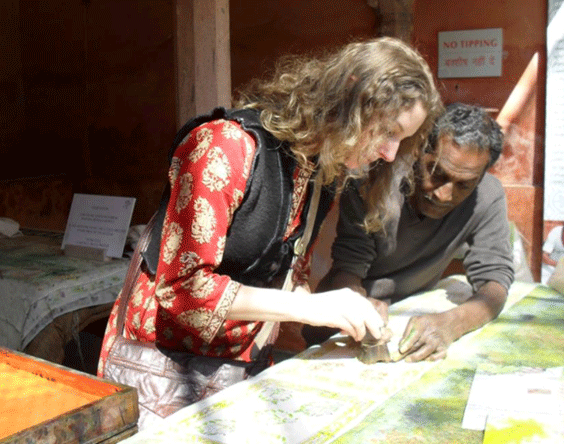
At the Anokhi Museum in Jaipur, I participated in block printing which is a renowned fabric printing process in the Indian state of Rajasthan.  The method uses hand carved wooden blocks to print a design on fabric. Each color layer is applied separately with a uniquely carved block. The block designs are meticulously chiseled by master craftsman employing very basic tools.  


I'll be available for custom orders from July 1st-July 14th. If you would like something made for you from my previous designs in jersey fabric (feel free to browse the "sales" section for ideas) please contact me at oohlajena@yahoo.com

Copyright © 2014 Ooh La Jena, All rights reserved.
You are receiving this email because you signed up for my mailing list at a craft show or you bought something at my Etsy shop


Our mailing address is:
Ooh La Jena
PO Box 34581
Philadelphia, PA 19143
Add us to your address book oohlajena@yahoo.com


Thanks, Jena, for posting on my blog.

Laurel
 
www.Laurelhoffmann.com- published books


 P: 215 884 7065
 ©Laurel Hoffmann, 2014, all rights reserved.


Monday, June 30, 2014

36: WHY I WRITE


Down and dirty was how I saw the fashion industry when I entered the field. But my experiences in the factories and designing departments drastically changed my mind.

Patterns, developed to produce a
company’s most expensive clothing,
are also often used to cut less expensive
clothing.
 
Contemporary Fashion Education student
Nzingha Ma'at fits her husband’s shirt. She
took the pattern off a shirt he owned that
fits him well. Nzingha uses Lance as her model
as he wears a size medium shirt. She has her own
 business designing high-end clothing, including
men’s shirts. Read down to the end of this post to
see her finished shirt and to learn how to contact
Nzingha to order the shirt.
 
 
I discovered that high-end industrial fashion technology combines the best of international high-end couture and American assembly line production.

In time I came to realize that this technology, most of which is not available to lay people, gives better, more professional results than home sewing methods, AND can be easily used in the home.

I became convinced that this information needs to be made available to the general public. I decided to write it down so lay people could understand and use the same procedures as high-end designing departments. I planned to write a book, put it on the market, and then paint pictures. But one thing led to another. The project took on a life of its own. The chapters that outlined the book turned out to be books. Then I was asked to teach in college. After five years teaching in the degree program I began teaching continuing professional education courses which enabled me to write courses that presented fashion technology as I thought it should be taught. My students asked for more courses. The amount of material needed to present industrial procedures turned out to be more extensive than I had thought it would be. Industry encouraged me. Twenty-eight years after being asked to teach in college I'm still at it, now with my own school. Two books are completed, a third is being copy-edited, the writing for four others is nearing completion. I'm not making any money, but the business is paying for itself. I don't seem to give up easily. Fortunately I have fabulous students who encourage me, and a supportive family. All of this plus encouragement from industry keeps me going. I thoroughly enjoy what I am doing. I'm meeting wonderful people, both here in Philadelphia and on the net. As has been said, its not the destination, it's the journey. 

Far better clothing than most people can afford to buy can be made at home if one knows how the industry sews. In the industry I worked with high-end, expensive clothing styles, other than in pictures, rarely seen by most people. These clothing styles are designed and sold exclusively to individual stores. The clothing is then cut and sewn to order for their wealthy patrons. Because fit is so important to sales, the patterns, developed to produce a company’s most expensive clothing, are also often used to cut less expensive clothing, the choice of fabrics and construction procedures being industry’s principal methods of reducing costs.


A treadle sewing machine can make clothing
worth thousands of dollars.


Industrial sewing procedures are both quick and proficient, and are often quite different than those presented in home sewing books. A treadle sewing machine can make clothing worth thousands of dollars. I was surprised to find that in the industry procedures I believed really important were largely ignored. On the other hand, procedures I thought to be of no value were extremely important. I also discovered that the higher end the garment, usually the less equipment needed to make it.


All sewing in industry is done on gauge. A gauge can be made by taping masking tape to the sewing machine’s bed, then marking the gauges on the tape, using a transparent ruler and permanent ink pen. In the industry all drafting and sewing is done to precise measurements. This attention to precise measurements makes it possible to produce clothing that adheres to standardized fit, guaranteeing, at least most of the time, that customers will consistently find clothing, in their designated size from their preferred manufacturer that fits. When I tried these procedures at home it became clear that these procedures can be used IN THE HOME to produce quality clothing for oneself and one’s family that fits and looks good.

Why isn’t this information available to the general public?


The factories train their personnel. New operators begin with setting hems, gradually upgrading their skills. This method, used by factories to train their personnel, greatly reduces the amount of training and time needed for operators to become proficient. Line assembly enables many people, each with specialized skills, to quickly produce professional clothing. But most factory personnel are not cross-trained, cannot make an entire garment as sewn in industry, and do not have the design room skills needed to draft patterns to a precise fit. Nor do they have the education or contacts to produce and market books that present how the industry sews.

Patternmakers and designers, many of whom do have the education and contacts, do not do the sewing. Many do not know how the factory sews. Their jobs pay well. Even if they do know the sewing, both they and factory personnel may not have the time or money to write books that may never sell.

It is my firm belief that information on how the industry sews should be available to laypeople. That is why I am writing my books, testing them with my students to make sure the material can be understood and used.


Lance models Nzingha Ma'at’s finished shirt. Nzingha teaches the industrial fashion methods she is learning to her students at ThirdEye Sewing Workshop, located in the Germantown section of Philadelphia. For more information about Nzingha's classes, call (215) 275-4117.

The African shirt design Lance is wearing can be ordered in three sizes. Contact Nzingha Ma'at for more information. Phone 215-275-4117 or  e-mail nzinghamaat@comcast.net


Watch this blog for more information about Contemporary Fashion Student entrepreneurs. Contemporary Fashion Students include entrepreneurs, fashion industry personnel, students who wish to enter the fashion industry, and people who wish to sew more professionally for themselves and their families.

The fall 2014 schedule for Contemporary Fashion Education classes is posted at http://www.contemporaryfashioneducation.com/schedule.html  Only two spots are left in each class.
For more information about my books visit http://www.laurelhoffmann.com/


 More later,

Laurel

www.Laurelhoffmann.com- published books

www.ContemporaryFashionEducation.com- school
Facebook: Contemporary Fashion Education, Inc.
http://contemporaryfashioneducation.blogspot.com/
https://twitter.com/LaurelHoffmann1


 P: 215 884 7065

 ©Laurel Hoffmann, 2014, all rights reserved.


Sunday, June 1, 2014

35: HOME SEWING PATTERN’S SLEEVE CAP/ARMHOLE PROBLEM

Testing a substitute
sleeve pattern

Think it’s YOU when a home sewing pattern doesn’t give you the results you hoped for? Guess again. The unhappy results may not be your fault!
 
A recent home sewing blouse pattern currently on the market has a sleeve cap whose sewing line is 3/4 inch shorter than the armhole’s sewing line.  This year I chose to use this blouse pattern in my school’s Grading &Sewing a Blouse and Jacket.

If you are using this pattern its sleeve cap’s sewing line needs to be increased at least 1 1/2 inches to provide the minimum amount of 3/8 inch of ease in the front and 3/8 inch of ease in the back sleeve cap; preferably an inch of ease through the cap. This allows enough ease for the cap to lie well over the top of arm, while not being so much ease that the ease causes a problem with sewing the cap into the armhole.


There are two options:


First option - If you have a blouse sleeve pattern that you have used in the past, substitute that sleeve for the sleeve in this pattern. Make sure that sleeve’s armhole sewing line is the same length as the new blouse pattern’s armhole length. This proved to be the best solution for the class, as shown in the pictures above and on the left and right. The sleeve pattern is from Simplicity 9210, unfortunately now out of stock.

I tested the pattern in a size 8, using the PGM professional Dress Form the company donated to my school as a part of their program to support fashion education and students.

The PGM Dress Form is an American Standard Size 8. Since the major home sewing patterns are all drafted to the American Standard grade rule sizing system, mixing patterns from any of the big four companies can be easily done.


Second option - If a satisfactory substitute blouse sleeve pattern is not available, lower the sleeve cap 1 1/2 inches at the sleeve cap’s underarm, as shown in the diagram below.


Mark the sewing line on the sleeve cap and the armhole. Measure the two sewing lines. The easiest way to do this is to walk the sleeve cap's sewing line around the armhole's sewing line to check that there is enough ease in the cap, as shown in the diagrams below.

NEVER trust the notches in sleeve cap/armhole patterns. ALL sleeve cap/armhole notches need to be checked before a pattern is cut and sewn in the fashion fabric.


To make the procedure easier to understand, the sleeve in these diagrams has no seam allowances. Seam allowances have been marked on the front and back bodice. In the above diagram 1/8 inch ease is put into the sleeve cap between the underarm and the first notches. This is also done between the front underarm and its first notch. This step is VERY important. One-eighth ease is ALWAYS needed in the cap at the curve under the arm.


After sliding the sleeve cap back 1/8 inch the underlying notches are traced onto the sleeve cap. The cap is then walked to the midway notch between the two bottom notches and the shoulder seam. The midway notch is traced. Finally the sleeve cap is walked to the shoulder, The underlying shoulder seam is marked on the sleeve cap.
 
Then the process is repeated with the front cap and front armhole.


In this diagram one sees the results. After the cap has been walked, the ease is now adjusted in the cap. The dark notches are the corrected notches. When sewing the cap into the armhole, lay the cap down to the feed. Because the feed-dog takes the fabric a little faster under the machine, it will help ease the cap into the armhole.


Note: Registration is open for Contemporary Fashion Education fall courses. If you plan to take a course, please sign up now as only three spots are left.
Books used in the program are also available for sale. All procedures in the program and its books are as done in high-end industry.

Laurel

www.Laurelhoffmann.com- published books

www.ContemporaryFashionEducation.com- school
Facebook: Contemporary Fashion Education, Inc.
http://contemporaryfashioneducation.blogspot.com/
https://twitter.com/LaurelHoffmann1


 P: 215 884 7065

 ©Laurel Hoffmann, 2014, all rights reserved.


Monday, April 14, 2014

34: Dress Form Usage


On November 14, 2013 I received this fabulous message:
The PGM professional dress form
given my school by the
PGM Dress Forms company.  
Hello, this is Brittany Yoseff from PGM Dress Forms, informing you of our New 2014 PGM Dress Form Private Fashion Draping/Sewing School Sponsorship Program!!!

As part of our worldwide sponsorship and for over 10 years, PGM has been giving back to Fashion Educational entities by donating professional Dress Forms to support fashion education and students. Plenty of fashion universities/colleges/institutes have gained PGM donations, including the top 20 Fashion schools in the US, which include: Parsons (The New School for Design), FIT (New York), Pratt, Kent State University, Academy of Art University (San Francisco), Savannah College of Art & Design, Rhode Island School of Design, Drexel University, Otis College of Art & Design, Columbus College of Art & Design, Trade Tech, FIDM and many more!

This New 2014 Private Fashion Draping/Sewing School Educational Sponsorship Program is to enlarge & broaden our Educational Institutions by donating; 1 Ladies Half Body Dress Form to private fashion schools, fashion design classes, sewing classes, draping classes, to help fashion instructors train students as well as to bring fashion industry partnership benefits. For more PGM Dress Form info, please visit: http://www.pgmdressform.com/dress-form-c1/.

So I did. And wonder of wonders, they gave my school a new dress form, shown in this photograph!

This post is to thank the
PGM Dress Forms Company for this fantastic donation and to show some of the ways it is being used at my school.

Here are the ways to date that the school has used the form:
1.  To develop basic patterns.
2.  To drape out and test design concepts
3.  To test and correct a commercial blouse pattern’s fit
4.  To check pattern corrections


1.  To develop basic patterns:

Paper patterns can be developed right on the form.
Students watch as I demonstrate draping pattern paper on the form to
create a size 8 basic pattern.
The paper is laid over the form and pinned, the darts folded into place,
and the neck and waistline clipped.


2.  To drape out and test design concepts
 
One of the students is interested in the Japanese pattern sculpturing.  On the left a tea bag box was taped to the form. Fabric was then draped over it to give the effect. To produce the same effect in finished clothing, the sleeve would need to be lined with firm, light-weight stiffening.
 
On the right lace is laid over the form to begin the process of designing a wedding dress.


I will post in the near future how to use a professional form to
3.  Test and correct a commercial blouse pattern’s fit
4.  Check pattern corrections


Note: Registration is open for Contemporary Fashion Education fall courses. If you plan to take a course, please sign up now as the classes are already half full.
Books used in the program are also available for sale. All procedures in the program and its books are as done in high-end industry.


Laurel


 P: 215 884 7065
 
©Laurel Hoffmann, 2014, all rights reserved.