Sunday, July 19, 2015

48: WHY I WRITE

Knowing industrial pattern making 
and sewing enables one to make 
clothing that may otherwise be
unobtainable. Here my children 
pose in their brother/sister sailor suits. 

Industrial sewing can be done on very basic machinery.
Treadles made clothing manufacturing possible.  


I thought it would take about a year to write what I knew.
After approximately 25 years I'm almost finished.  :-))
It was just as well that I didn't know what I was getting into.

Years ago, having retired from production pattern making to raise my children, I decided that the pattern making and sewing methods used in designing departments should be available for laypeople to learn and use.

Contrary to popular opinion, Industrial sewing can be done on very basic machinery, it can even be done on a treadle.  In fact it was the invention of the treadle sewing machine
that made it possible to move clothing manufacturing into the factories.


Treadle sewing machines 
made both anti-bellum
gowns and manufactured 
clothing possible. Sewing
could now be produced
within a reasonable 
ime frame.
One can date when the treadle sewing machine was invented as it was then that anti-bellum gowns became fashionable, gowns that involved yards and yards of sewn fabric, advertising the affluence of a woman’s husband.

When I entered the industry I was stunned to learn how differently the industry sewed. The methods used in industry were so much easier and much more reliable. As I learned pattern making and grading, needed for my job, I made sure to also learn the sample making procedures. I wanted to be able to sew professional clothing or my family and myself at home like that made in the designing departments. I asked the sample makers how they sewed. Although not allowed to sew on the machines while on the clock (I was management, not union so therefore was not allowed to sew on the machines), I practiced at lunch and at home.

Once retired to raise my children, I began sewing at home. I bought home sewing patterns to speed the drafting, using the same drafting procedures to set up the purchased patterns that I had used in the industry, as rarely are industrial patterns drafted from scratch. Most patterns used in the industry are modifications of previous patterns for garments that have sold well the previous year. Before I had gone into the industry I had made clothing using those instructions. But only about one in three garments were ever really successful. No wonder. The instructions were awful! I decided to rewrite them. I figured it would take me about a year.

One book turned into six, then seven, now eight, with spin-off booklets.
New covers are planned for some of the books. In the meantime others are being copy-edited.
So far three are on the market.
I write everyday.
What keeps me going? My students' enthusiasm. 


When Philadelphia University asked if I would like to teach in
Continuing Professional Education it gave me a chance to
develop my program. My adult students told me what they
needed. They were terrific.

Maybe it was just as well I didn’t know what I was getting into. I"ve been writing for approximately 25 years now.

For the last several years I've
been renting space and teaching
at our local Catholic church.
But my students prefer private lessons. 
So I'm now teaching out of my home.
I never thought the one book I had decided to write would turn into books, a publishing company, years of teaching in college while developing a graduate level program, or in having my own school. Once I moved over from the degree program to teaching in Continuing Professional Education I was free to write and teach, using my own methods. My adult students asked for what they needed, enabling me to learn what was needed in the books,and how the books needed to be written.

Christine grades her patterns to her fit. Knowing how to
correct and grade home sewing patterns speeds the work.
Success! Christine tries on her jacket's
muslin. Understanding grading
enables Christine to eliminate hours
of fitting. 
 My goal was to produce  heavily illustrated picture books that would take a layperson step-by-step through the process of drafting and sewing that would enable her to correct her patterns to her personal fit, and then use the easier industrial sample making procedures to produce professional garments; clothing that would not beg the question, Did you make it?

Rotating each bisection begins
the process of drafting a princess seam.

A true bust dart, drafted
to the true bust point, is bisected.
I hoped to eliminate all writing – I wanted to have just pictures in the book. But I found I had to add writing as my students also needed written explanation. However, the emphasis continues to be on the visual, as most people who sew learn from the graphics, reading the captions and copy only to clarify the diagrams.

Having worked in couture, I like to
 in
clude  high-end  instructions,
just in case a student might want
to set matched bound buttonholes.


In the industry seamstresses who set zippers set 500 a day. This illustration shows the first step. Once learned one needs
no pins at all
 to set this, a lapped, hand-pricked zipper in 5 minutes or less. And it sets perfectly every time, closing the seam right on the seam's sewing lines.

Why isn’t this information already on the market?
Here are four of the reasons this information isn't available:

1. Most of the people who do the sewing in the industry are not college educated. Those who become sample makers (seamstresses who can sew an entire garment together using the sewing procedures that will be used to make the garment when it goes into mass-production) have risen up through the factory ranks, learning industrial procedures step-by-step until they know the whole process. They are then promoted into the designing department where they sew the sample garments as those garments will be sewn on the factory floor, checking for problems as they sew the garments together. Although intelligent, because they do not have college degrees they rarely, if ever, are hired to teach in college. They also rarely have the skills, or the opportunity to write down the sewing methods they have learned in industry. This is the fundamental reason the sewing books on the market present home sewing.

2. Few people, including the editors at publishing houses, know how industrial sewing done. This is unfortunate as there are many people who might be able to manufacture small runs of sewn products in their home and sell them in local stores or on the net. There’s no way anyone can be truly successful with sewn product manufacturing if they don’t have industrial skills. Home sewing methods just take too long and too often produce less than professional results.

3. Because pattern making has a symbiotic relationship with sewing, patter nmaking skills have to be included with the sewing instructions. Pattern making requires good fitting skills. In other words, books that give the information that is needed are difficult to write and illustrate. As I have found out, it takes years and requires classroom testing to be sure the information is accurate and can be understood.

4. Before the computer it was impossible within a reasonable time frame to diagram and write this material so that lay people could understand it. Just one of my books would have taken a life-time to complete.

5. The home sewing books sell. Publishers prefer to publish books that have a guaranteed market.


Here are some of the problems caused by lack of access to this information:

1. Industry doesn’t know where to find the trained workers it needs.

2. Many people who are highly proficient at home sewing might like jobs in the industry, but unfortunately they need to be retrained if they are to be hired. Home sewing procedures can NOT be used in the industry.

3. Because factory workers are specialized, few are cross-trained. When the factory system left the USA, most of the factory seamstresses didn’t have the pattern making skills they needed that would have enabled them to start manufacturing small lots in their homes.

4. And it is a problem for young girls. Industrial sewing and pattern making is low level engineering. Learning industrial sewing is an excellent preparation for a future in engineering.

5. Because home sewing is taught in many, if not most fashion training programs, students are often unable to get jobs in the fashion industry.
   
Knowing how to produce professional garments is fun.

Why learn industrial patternmaking and sewing?
Knowing how to produce professional garments is fun.


e-mail

 Phone: 215 884 7065


© Laurel Hoffmann, 2015. All rights reserved.
All material on this blog is copyrighted by and is the exclusive right of Laurel Hoffmann.

Saturday, June 20, 2015

47: QUILT

A double-hearth quilt, made by a child in the late eighteen hundreds.
My grandmother, Florence Patrick Crispin who was born in 1886, made this, her best quilt, when she was a child, cutting its blocks from her outgrown, used clothing, piecing, and then sewing the blocks together on a treadle sewing machine. She gave the quilt to me, her son’s daughter, when she broke up housekeeping. She said it is called a double-hearth because it has two small blocks at the center of each repeating design.
The two small squares in the center of each design represent 
a double hearth. More pictures of the quilt are shown at
the end of this post. 


At a time when women made many of their families’ clothing, learning to quilt enabled young girls to learn fundamentals about fabrics such as fabrics’ various weights; the importance of cutting and sewing on grain; and how to recognize and effectively work with color palettes including how to blend patterned and solid colors.

Notice that each block is cut on grain to its perfect shape, then sewn on perfect gauge, allowing the quilt to lie flat without any puckering. Grandmother was also well aware of personal color palettes and always chose fabrics with colors that enhanced the intended wearer’s color palette. I suspect he learned this from the women in her family as her quilt shows that her clothing was cut from fabrics in her autumn palette.

Mr. Rich Guido, Administrative Librarian of the Salem 
County Historical Society (New Jersey) accepts 
Florence Patrick Crispin's best quilt from her 
granddaughter, Laurel (Crispin) Hoffmann, June 16, 2015.
As did my grandmother, I protected the quilt in her hope chest that she gave me until donating the quilt to the Salem County Historical Society (New Jersey) in June of this year (2015). That is why the quilt is in like-new condition. It has been carefully preserved for over 100 years.

Quilts, made by the bride from her childhood clothing were a form of album, evoking memories of her past. The men lived with their biological families on their family’s homestead, taking over the farm as their parents aged. The women moved to their husband’s family homestead. Quilts made from childhood clothing helped to retain the bride’s memories of her former home. Grandmother pointed out which blocks had been cut from her apron, etc.


The Crispin farm (homestead) where my grandmother moved
when she married in 1909. She had first worked there as a
seamstress, making clothing for her future husband and his parents.
My grandmother also made a second-best quilt, probably worn out and discarded long ago as grandmother, like most farm women, wasted very little. She said when she became engaged in 1909, the women on her side of the family quilted her best quilt (the double-hearth quilt), the women on her soon-to-be husband’s side quilted her second-best quilt.

After my grandmother finished eighth grade she took a local sewing course with her younger sister, Meta (Patrick) Gosling who took in sewing in Woodstown after she was married. Although Grandmother’s technical training was limited, she was naturally good at fit and design. She sewed for various families, moving from farm to farm, living with each family during the time she was making them their clothing as was then the custom.

Alvin S. Crispin proposed to the pretty young seamstress, 
hired by his mother to make his clothing, They were married in 1909.
In this picture, probably taken in 1948, he holds his prized work
horses, Don and Mac. The horses were huge, but because Grandfather
was very tall and muscular, the horses appear to be much smaller
than they actually were.
She met my grandfather when she was hired by her future mother-in-law to make clothing for him and his parents. My grandfather was 6 foot 3 inches tall and very muscular. My grandmother was 23 years old, petite, a very pretty young woman with long black curls. Sixteen years younger than his older brother who now operated an adjoining farm, I think my then shy, 21-year-old grandfather was smitten.

Grandmother was married in a green dress which she probably made herself. She told me she later cut the dress up to make dresses for her little girls, her first two children. Although after marriage she never sewed again for profit, she continued to make and mend clothing for her family her entire life. It was always important to her that her family look decent.  She made and bought most of the clothing I wore as a child. I was NEVER allowed to wear jeans into town. In old age she mourned that her hands shook, preventing her from threading a needle.

Grandmother was always careful with money, having been very poor as a child. She told me when she was growing up she would take off her shoes and walk barefoot to her destination, putting them on when she arrived. She did this to save shoe leather. She helped her family by plowing in the fields. Her hard work helped her parents, who had started out as share croppers, to later buy a farm and to be able to buy bicycles for her younger brothers. They were even able send her youngest sister to teacher’s college.

Here I am with my grandmother at my wedding reception
in 1970. I begged my grandmother to teach me to sew
when I was eight.  It paid off. When this picture was taken
I was working as a grader/pattern maker/fit model at 
Corner House in Quakertown, PA.


In the late forties Grandmother would take me with her to Philadelphia to shop. Just before we were about to go home she would say, I also need to buy a little fabric. And we would go into Karlins, a premier fabric store then on 9th Street where she would buy several yards of fabric to make her current project. Grandmother never had a cache of fabric on hand. She bought as she sewed.


This picture shows the quilt's backing. Both the backing and the 
quilt's edging seem strange choices, considering the colors
in the front of the quilt.

A close view of the blocks.

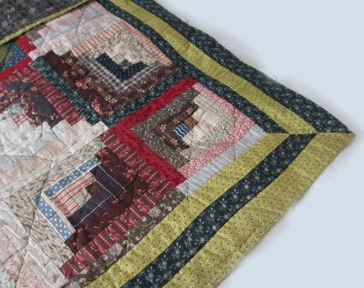
A corner of the quilt. I find it interesting that the strips that finish
the quilt change colors at the mitering.


Laurel


e-mail

 Phone: 215 884 7065


© Laurel Hoffmann, 2015. All rights reserved.
All material on this blog is copyrighted by and is the exclusive right of Laurel Hoffmann.

Tuesday, March 3, 2015

46: DOLL CLOTHES


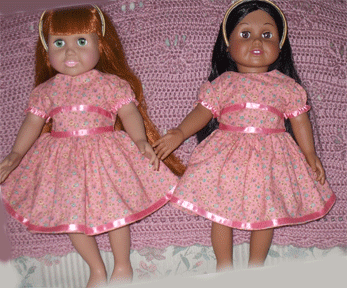
Here are the new dolls, ready to go to birthday partys!


Here are the doll dresses Janet, Contemporary Fashion Education student, decided to make her two great-granddaughters, age 5 and 7, for their Christmas dolls.


Halloween may be months away, but
it's always good to have one's costume ready!


The dolls and pattern books were bought from Nancy’s Notions website. Janet slightly changed the doll patterns, setting the patterns up so she could use the professional sewing techniques she had learned in class.


A second set is a good idea.
Ready for vacation in new Capri sets.
 The pictures look the same as presented on the patterns, but when one looks inside of the dresses one sees that the sewing is different than it would have been if the patterns’ instructions had been used.

Ready for bed in warm winter gowns.
Note the bunny slippers worn with summer nighties.


These dolls are planning to go to many parties. So here they
are again dressed in their second party dresses.

The great-granddaughters loved the dresses. One said Oh my G-d! The other didn't say anything at first, then looked to the older grandchild for help in dressing her new doll. Janet plans to make more doll clothes for her great-grandchildren.


Books are available for sale. 

Visit www.Laurelhoffmann.com - to order published books, 

e-mail, or phone 215 884 7065.

Visit www.ContemporaryFashionEducation.com for more information about the  school

© Laurel Hoffmann, 2015. All rights reserved.
All material on this blog is copyrighted by and is the exclusive right of Laurel Hoffmann
with the exception of the photos, which are printed with Janet's permission.


Saturday, December 20, 2014

45: WINTER 2015 CLASSES

Thinking of starting a business?
Or maybe you need some nice new clothes and are tired of trying to make due with whatever you can find in the stores. 


Rose Christopher, 
owner of  Victorian Vanities
models a mourning dress
she made to present information
about Victorian mourning customs.
Now is the time to learn the skills you need to make clothing that fits
and that you will really enjoy wearing. Janet, who has since finished
this certificate program,
 models her blouse in progress.

Now is the time to learn the skills you need to make exquisite clothing like that sold on Madison Avenue and/or to start your very own fashion business. Learning these skills will give you a wardrobe everyone will admire. Do you know that the sewing methods used in industry are different than the sewing methods used by home sewers? The professional skills taught in this program will help you start that fashion business you have always dreamed of.  

Two courses are offered in January: Drafting & Fitting Pants and Skirts and Grading & Fitting a Blouse and Jacket.  Drafting & Fitting Pants and Skirts is open to new students. Grading & Fitting a Blouse and Jacket is open ONLY to students who have completed the prerequisite, Fitting Home Sewing Patterns/Grading to Fit. 

Here is the link to the course order formInformation about these courses is below. 


The sewing in the program is
demonstrated on this
Feather-weight 
made in 1941,shown above,  a machine
 that only sews forward and back.


You do NOT need sewing experience. When you begin this program you need only to be able to sew two plies of fabric together on your machine at home. 

You do NOT need expensive equipment. Whatever sewing machine you already have will be more than adequate. In fact, the higher-end the garment, the less complicated the machinery needed to make it. 

You will need some simple drafting tools, the same drafting tools used in the industry to draft patterns. 

   
Each student drafts and sews to her personal fit.


Each student drafts and sews to her personal fit, learning in the process how garments need to be drafted and sewn to fit real human people.
  
Laurel explains a drafting procedure to Kathy


All procedures are demonstrated as many times as needed for students to learn the work. All procedures are hands-on. All procedures are as done in high-end designing departments.
Drafting & Fitting Pants & Skirts
10 three-hour classes on Saturdays
                                                    
Custom fitting a correctly drafted
pant pattern produces a muslin
that fits.

 
Preventing pulls under the
crotch requires expert drafting,
as taught in this course.


is offered in the afternoon from 
1 pm - 4 pm on Saturdays

January 17, 24, 31,
February 7, 14, 21, 28,
March 7, 14, 21
 1 pm - 4 pm

$350 for the 10 week course


Classroom testing over the past 20 years
ensures that the formulas work.


Students also need to buy Drafting & Fitting Pants and Skirts and Sewing Pants and Skirtsa 2 book set. that enables the students to draft their pant patterns to fit in 10 weeks. 

                     
                            Prerequisite: Fitting Home Sewing Patterns/Grading to Fit
No exceptions 
10 three-hour classes on Saturdays


In the prerequisite course
students developed and 
tested personal slopers. 
Here Laurel checks 
Cheryl's sloper.
First session - winter:
January 17, 24, 31, February 7, 14, 21, 28,
March 7, 14, 21
 9  am - noon

Second session - spring:
April 11,18, 25, May 2, 9, 16, 30, June 6, 13, and 20. 
No class May 23 - Memorial Day weekend
Price: $350.00 for each session
9  am - noon

                               $350 for each 10 week course


 Because this is two courses taught simultaneously,
most students will need to take this course twice.

This classroom tested book
contains 384 fully diagrammed pages.
This classroom tested book 
contains 304 fully diagrammed pages.


Textbooks
Students also need to buy either Grading & Sewing a Blouse  $75.00 wholesale, plus $4.50 tax $79.50, or Grading & Sewing a Jacket$95.00 wholesale, plus $5.70 tax $100.70.


In the Fitting Home Sewing/Grading to Fit course students developed personal slopers. Slopers are basic patterns from which style patterns are developed. Stephanie models a muslin bodice that was cut from a pattern drafted from her custom sloper. A skirt has just been draped and pinned onto the bodice. A strapless neckline has been marked on the muslin. The end result will be a gown she will wear to a costume convention. 

In the upcoming blouse/jacket course Stephanie will grade a blouse pattern to her custom fit using the grading coordinates she developed in Fitting Home Sewing Patterns/Grading to Fit. Read about Stephanie's activities with costuming, 


Laurel 


Course order form

Books are available for sale. 

Visit www.Laurelhoffmann.com - to order published books, 

e-mail, or phone 215 884 7065.

Visit www.ContemporaryFashionEducation.com for more information about the  school


© Laurel Hoffmann, 2014. All rights reserved.
All material on this blog is copyrighted by and is the exclusive right of Laurel Hoffmann.


If you decide to buy any of my books, please consider the following:

Illegal copies of books are often offered on the net as used, like new to avoid the copyright laws. Priced slightly below the author’s book prices, customers are unaware that they are buying what may be an inferior copy. All of my books are constantly being classroom checked for accuracy. Any of my books, sold as used, like new, are out of date and may be illegally copied. 

All of my books are printed in-house, by my business. To receive the latest, updated book, please purchase my books from any of the websites listed below:


Two companies on the net are also authorized to sell my books.  

The books can be purchased from Inside Fashion’s bookshelf at http://www.insidefashionlive.com/Bookshelf/tabid/94/Default.aspx.

Fashiondex sells Design Room Techniques at this link: http://www.fashiondex.com  store/proddetail.php?prod=125&cat=34

Tuesday, November 25, 2014

44: BEAUTY SECRETS

Here are some inexpensive products that REALLY and TRULY work, all of which I've tested, use, and recommend to my students:
CeraVe Moisturizing Cream, $14.99 at Walgreens
Size/Count 16.0 oz. 
Huge bottle, lasts all winter


Palmer’s Cocoa Butter Formula with Vitamin E
Sold everywhere for just under $10.00


Palmer’s Cocoa Butter Formula with Vitamin E heals & softens rough, dry skin. Amazing how much difference this product makes, especially in the winter. I prefer the plastic bottle with the pump, shown here.
For removing make up
Cetaphil Gentle Skin Cleanser - For all skin types, this mild, non-irritating formula softens as it cleans. Priced at just under $10.00 for 16 fl oz (473 ml) A bottle lasts forever.

Glycerin soap is an all purpose soap that is gentle to the skin.
Cruelty-free, biodegradable, natural, no artificial colors.
I buy 10 or 12 cakes at a time. I use it not just in the bath, but also to remove stains from clothing, including ball pen ink. It's one of the best kept secrets around. Find it at Whole Foods.

Pregnancy safe, formaldehyde & Dibutyl Phthalate free,
this is the nail polish to use if you have problem nails. 
For nail care visit the company's site.


Although this nail polish comes in every color of the rainbow, my all time favorite is the color, Protect Plus Color (Pink) Ref# 1071, that you see here. $16.00 and worth every penny!


Not sure of what color lipstick is the best color for you?
Tangee is the answer
Tangee Lipstick $14.95 is the Original Tangee Lipstick that changes color to complement your skin. Visit the Vermont Country Store for that and many other products from long ago that really work.
AVEDA foundation

inner light™ mineral tinted moisture broad spectrum spf 15


This is the best foundation I have ever used. You will need to go online to find a store to learn where to buy it the first time so as to determine the right shade for your skin.


Available at CVS and the Acme among other stores for approximately $1.50 for a 32 fl oz (1 QT), TRESeeme' MOISTURE RICH conditioner is the solution for preventing winter dried out hat hair.

Glop it on after shampooing. Use plenty, at this price you can certainly afford it, and you'll be overjoyed to find the difference in your hair..


One last tip. Buy a pair of gloves to match every winter coat you own. Put the gloves in the coats' pockets so as to have them available every time you are outside.

Laurel


e-mail

 Phone: 215 884 7065

© Laurel Hoffmann, 2014. All rights reserved.
All material on this blog is copyrighted by and is the exclusive right of Laurel Hoffmann.