Saturday, June 8, 2013

17: FASHION SHOW


What are women who sew making? Here are a few answers.
 
This post features members of the Greater Philadelphia Chapter of the American Sewing Guild modeling clothes at their annual fashion show.


Hope you enjoyed the show. I’ve chosen the best of the pictures I took. There were many more impressive outfits. This is a very creative membership.
 
Bye for now,
Laurel


Monday, June 3, 2013

16th POST: DESIGNING A VERY SPECIAL DRESS


On the left Shira and her brother Jacob pose in the synagogue. Shira is wearing the dress she designed and that I helped her make. The process is described below...


Shira, my 12-year-old protégé asked if I would help her make a special dress for her Bat Mitzvah, a ceremony that is a rite of passage when she, as a Bat Mitzvah, would acquire the rights, responsibilities, and privileges of an adult Jew. She needed a really special dress that would reflect the importance of this ceremony.
 

Shira and I began by sketching the dress.  We did three designs. The first design had a bow in the back. The second design had cap sleeves. The third was the design Shira decided she liked the best. I was very happy with her choice.  

 
As she described the dress I sketched the dress on tracing paper laid over croquis illustrations copied from The Apparel Design and Production Hand Book But one could lay tracing paper over any illustrations or photos found in magazines and sketch clothing designs.


We used the skirt pattern Shira had already drafted, combining it with bodice patterns we developed from a McCall’s Enchanted Forest pattern I had bought years ago.

 
Next we tested the drafted patterns in muslin. There were three fittings.  The first, not shown, was done with the basic bodice. The seam lines were marked, then the pattern was split to create three bodice pieces. The shoes were found on line.


Once we were sure of the design and fit it was time to visit the fabric store. We shopped at Gaffney Fabrics, 5401 Germantown Ave. at the corner of Coulter Avenue in Philadelphia.


Shira chose apricot and gold satin fabric. We also found gold trim that matched the design of the shoes. Gold metallic thread was purchased to use with sewing the trim.  Labels were later purchased, as one should always sign one’s work.

This is the last fitting, a check to make sure that everything is done correctly and that the outfit is ready for the big day. A jacket completes the outfit to cover Shira’s shoulders during the ceremony. The back is now open between the top of the skirt and the bodice. The braid now provides straps to hold up the bodice in the back. The skirt closes with an invisible zipper. The dress is fully lined with the same fabric used to make the shell.

Shira is really happy.


Later, the ceremony over, Shira has her picture taken with many people, including the most important man in her life. This is a special day for everyone.  We all celebrate at a fantastic party. 

Shira has the most fun of all.  


To see a larger better view of this video visit Contemporary Fashion Education, Inc.
 

Here's Shira's wonderful mother Amanda with her friend Bob.
Amanda is the hostess who organized and arranged this fabulous  event.
 

Bye for now,

Laurel


Tuesday, May 21, 2013

15th POST: TRIMMING CUFFS


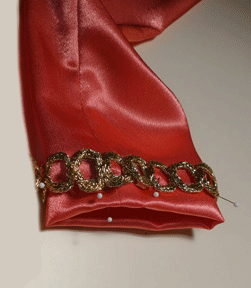
This light-weight satin jacket’s sleeve is being trimmed with a metallic braid.
Woven fusible interfacing gives the cuff stability.  The fusing has been sewn to the edge of the cuff, raised-stitched, turned over and fused to the sleeve’s hem, as shown above.


The sleeve’s hem is turned up and pinned. The trim is then pinned one-half inch from the finished edge of the cuff so that the trim’s placement is consistent with the trim on the ensemble.


The trim is sewn to the sleeve with metallic thread. Because sewing the ends of the rather thick braid into the seam would bulk up the seam the ends of the braid are tucked under the braid. This worked really well as the braid’s metallic yarns wrapped around each other, concealing the join.
Finally the sleeve’s hem is sewn under the braid rather than at the top of the hem to prevent the hand hemming from showing.
 
The sleeves are now ready to be sewn into the armholes.


More later,
Laurel

Friday, May 10, 2013

14th POST: BUTTONS AND SNAPS


I'm making a silk chiffon blouse. Testing proved that neither a bound buttonhole nor a machine buttonhole would work with the silk chiffon blouse fabric. (Note: the above picture shows the true color of the fabric. )

The only solution was covered snaps, often used by haute couture designers. But first the button problem had to be solved.

 My button box yielded up only one set of buttons that matched the fabric, but they were too small. Sewing them over mother-of-pearl buttons cut from a trimmed place setting solved the problem.
When using covered snaps first sew all the buttons on the garment before covering the snaps. As each snap is covered sew it in place on the garment immediately before covering the next snap.
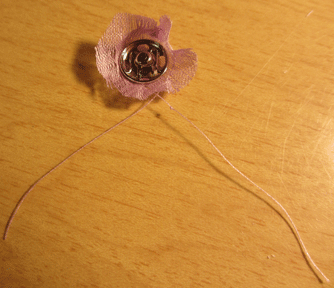
Now cover the snaps. Cut a circle of the fabric, twice the diameter of the snap.  The circle does not have to be perfectly shaped. For the stud side fold the fabric in half and half again. Snip a tiny hole across the center that is slightly smaller than the diameter of the snap’s stud. Do NOT cut a hole for the receiver side of the snap. An indent will form with the finished snaps are closed, solving the problem.


 Hand baste around the edge of the fabric. Be careful as the fabric frays easily.
Gather the fabric.
Sew across the back.

The covered snap
Sew the snap on the garment.  This side receives the stud. When the snap is closed the fabric will indent.
Bye for now,
Laurel

Friday, May 3, 2013

13th POST: DREXEL UNIVERSITY URBN CENTER

 
Last month I attended the opening of Drexel University’s $80 million industrial warehouse-style URBN Center. Talk about fabulous!
 
While there I made sure to visit its costume collection’s new location. Philadelphia fashion columnist Elizabeth Wellington wrote about this high-tech storage space in her column Mirror, Mirror, published in the Inquirer’s Style-Soul section this past Wednesday, May 1.  According to Ms. Wellington’s article, What's in Drexel's closets? Timeless textile treasures, Allen Sabinson, dean of Media Arts and Design said the idea [for the Historic Costume Collection]  is to pull from the grouping for fashion exhibitions and to be a go-to research facility for couture, ready-to-wear, and costume designers.
 
Below are some of the pictures I took of the fashion design department, one of many Antoinette Westphal College of Media Arts and Design majors now housed in the building.


The space now available for this major is unbelievable. Huge cutting tables, beautiful Juki industrial sewing machines, new dress forms, plenty of locker storage.